Oh noes, not another family history blog! Probably what makes this different to other genealogy blogs out there is not its focus on one person's family history (I'm sure there are plenty of those) but the age of yours truly, the author. I am the only genealogist I know personally who is under 45. Consequently not only will you see the normal ponderings on people, places, events, brick walls, local heritage and research, but also memes, pop culture references and the odd expletive.
September 29th, the Feast of St. Michael the Archangel, is also National Police Remembrance Day in Australia, commemorating the lives of officers who died in the line of duty. I have a few police in my family, most notably Thomas Skermer, International Man of Chicanery. Thankfully, the rest were nothing like that at all, and today always makes me think of one of the 'good guys', Walter John Wissell.
Walter Wissell was my 1st cousin 3x removed. He was born on 11 Apr 1881 in Echunga, the area where most of his family lived including poor dear Nellie Cunningham who was Wissell's first cousin. His father James had a dashing backstory, as he is believed to have served in the US Civil War before starting a career in whaling and jumping ship in Australia. James married the young widow Janet Brown nee Gall in 1867 and the couple had 7 children in addition to Janet's existing two from her first marriage.
Details about Walter Wissell's death reported in The Observer and The Register
During his time in the police force, Walter had been an active member of the South Australian Police Association, a group which had been formed in 1911 and which today still carries out the mission of representing the members of SAPOL on all industrial matters. The Association believes that Walter was transferred to Kadina as a direct result of his involvement in a pay dispute and that as such his death was a direct result of his involvement in the union. As part of their centenary commemorations, the Association organised to have Walter's grave at West Terrace Cemetery refurbished, and a service was held by his grave to acknowledge his contributions to keeping South Australians safe, as well as helping his fellow police officers.
The refurbished grave of Walter Wissell at West Terrace Cemetery
Walter's grave lies in one of the many less-maintained sections of the cemetery, and so his grave stands out among the others. It's great to see an organisation value their pioneers and heritage in such a visible way.
I've mentioned previously that I have some rather significant brick walls with my mother-in-law's family. That's right, the woman whose grandparents are surnamed possibly James, unknown, unknown and Smith. Her paternal grandmother, possibly surnamed James, married William Taylor (who was definitely NOT her grandfather), and then Walter Herbert Russell, who I mentioned I'd had no joy tracking down.
When doing family history on a budget, it's easy to omit ordering certificates. The information such as names, dates and places can sometimes be located elsewhere, so all you're finding is detail, right? Well, on Elsie and Walter's wedding certificate, one of the details I had discovered about him was that he was working as a Ganger, which could mean 'a foreman of a group of labourers', or possibly a rail track worker.
Join GenealogySA to access low cost transcriptions... especially compared to the cost of SA certificates!
Now, many of the details on that certificate are inaccurate, as it common to any document linked to Elsie (or, as I prefer to think of her, liar-liar-pants-on-fire.) However, I was working from the assumption the employment was accurate, having been provided by Walter rather than Elsie. This lead me to consider he might be a match for an electoral record on Ancestry for a Ganger living in Rodinga, NT in 1937. I'd always suspected the marriage had collapsed, but had been searching for him in NSW where Elsie had briefly lived. This prompted me to turn my attention to other states and the NT.
While I couldn't locate him in any other NT records, I did find a WA record for a Walter H Russell who died in 1945. There was no evidence to particularly suggest it might be him, but there were no other records even close to matching so I thought 'what the hell?' and sent away for the certificate. This is what came back.
That's a whole lotta 'unknowns' right there...
A funny thing: I've never received a certificate with more unknowns, yet this has told me exactly the bits I needed to know. He was 56 and born in Anna Creek, so definitely my guy! It also tells me all the things I didn't already know, his illness, death, and burial which was witnessed by local Kimberleys identity Robert Rowell. It also explains why nobody seemed to know what had happened. Even now, that is a very remote part of Australia, let alone in 1945! Having been born in Anna Creek, a highly remote part of SA, Walter probably felt right at home, but it sure makes a man hard to find!
Cockatoo Island, death place of Walter Herbert Russell. I'd tell you how far that is from Anna Creek, but Google won't calculate it because it's apparently just too off-grid!! Maybe 2400kms/1490mi?
So, there you go, order those certificates and find answers in the obscure details. One slight obscure-detail question though... two children, one deceased? I only know about one of those! More questions!!!
As a hobby genealogist, I probably spend as much time developing my three key networks as I do actually researching. They are:
1) The wider family and local history community,
2) The cousins, especially those who research our family,
3) My online genealogy networks (eg Twitter).
Yes, this takes away a lot of research time, but it leads to much better research.
Exhibit A:
Recently of course it was May, and in South Australia that means one magnificent thing: History Month and the History Festival. It's hard to juggle the events with the little twigs and work, but I get to as much as I can. One of the things I did this year was go to the Open Day at State Records, an experience I highly recommend. I got to tour the Archives, hear about some of the items, and get some research assistance. It was also a chance to mourn the decision made by the Chief Archivist during one of the wars to pulp most of the inquest records to retrieve paper... Why... why...
Or in this case, I don't always pulp records, but when I do they're the most interesting ones...
1) That they'd been turned in by their only-slightly-older sister Amelia*. Amelia had escaped the family dysfunction by marrying at 14. She gave birth to her first child just before her 16th birthday, took on the care of her three younger siblings who had been abandoned by their mother Ellen, and then had her first child die. I can well understand it got a bit much.
2) That the children were fostered out to their childless aunt, Asenath Bacon.
3) That a few years later they had been removed from Asenath and sent to Solomon Wiseman.
4) That State Records' copying service is really, really cheap.
Says it all, really
The records referred to item #3 as being referenced in a set of Minutes, the problem being the Minutes are part of a government record series which is sealed as it contains details of adoptions which took place less than 100 years ago.
The lovely people from State Records helped me get all the information I needed to lodge a Freedom of Information request for the minutes. They tell me that, given the age of the records I'm after, I'll certainly be granted permission to access that section of the record series, and while there's no telling what I'll find, it's probably the only possibility of a definitive answer to the Family History Mystery of how the children of Walter Lavis (impoverished bigamist at large and former inmate of Adelaide Gaol) ended up inheriting thousands of pounds from Solomon Wiseman when there was no apparent connection between the families at all.
Meanwhile...
I emailed my relatives on that side of the family to update them with my findings. All of us have been working on cracking this one for years. We have notes from 30 odd years ago where family are pondering over theories on what happened. One of my relatives said she also had an update for me, and let me know that Ellen had remarried (possibly bigamously) to James Pitt in Jamestown in 1884. However, and more interestingly, in between her second and third marriages she had a child named Edith May Norbury. Poor Edith was not blessed with long life, and passed away in Yancowinna Station, Silverton, in 1885.
What's interesting about that?
A little google of my DLF Solomon Wiseman once lead me to the piece of information that, before becoming a grazier and even before becoming one of the original BHP share-holders he was, of all the unexpected things, a rabbit inspector.
You have to start somewhere, even if your grandfather is King of the Hawkesbury
Armed with that information I consulted the ever-reliable and constantly surprising Trove, where I found out that...
I see you, you wascally wabbits
In 1885, Solomon Wiseman was in Silverton on at least two occasions.
Now, I know that's not evidence of anything, but by working with some of the fantastic networks out there I have placed Ellen Pitt nee Clifford nee Lavis nee Maynard and Solomon Wiseman in the same town in the same year, not two years before her children were moved to his care. Coinkydink? Possibly not! At the time the population of Silverton was at its peak, roughly 3000, which is still quite small enough for them to have met, especially since Ellen was at a Station and Wiseman is described as visiting Stations.
Now to wait for the results of the FOI request! Hopefully they add more detail than Nellie Smith's death certificate which turned out to be a dead-end of 'unknowns'. Watch this space!!
*Amelia went on to ditch her own family of 8. She fled to WA, had another 7 to someone else, and lived to the grand old age of 94.
A while back I alluded to the fact I'd received a mysterious comment on Ancestry. Someone had commented on the image of my great-grandparent's marriage certificate that they had the original. That line of my family is very small, so I was pretty surprised to say the least. After quite a few delays, I met up with the lovely woman who commented and she handed me over two items she found while cleaning out her shed. It turns out her husband's grandfather married my great-grandmother, which goes to show that you never know who will still have items of interest to your family!
1) A picture of my great-aunt Annie
This is quite unusual. It's made almost like a badge is, with the back pressed into the picture. It's a photo I already had, but it's very special to own the one which actually belonged to my great-grandmother and was probably on display in her house.
2) The marriage certificate
Obviously I had applied quite some time ago to get a copy of this, and so had all the relevant information already. You'll see it points out things like the occupation of the participants' fathers, their current residence, age at marriage etc.
One of the things this shows is that Margaret said she was 21, the legal age to marry without her parents' consent. A year later when Annie was born she was recorded as being 19. On the original you may notice a teeny tiny difference...
You can actually see where someone (lookin' at YOU here, Margaret) has changed the year so that it shows how old she really was. And this people, is why you want to get original certificates where-ever possible.
A slightly old meme, I know, but I couldn't resist...
I know it's generally an impossible challenge to get through your genealogy to-do list (and by 'yours' I mean 'mine'). I look on with envy at people who have dipped into land records, published their book, made their scrapbook or whatever. Somehow between work and the little twigs I never seem to get that far! However, there's one thing I always make time for: regularly revisiting sources I've already looked at to see if there's anything new which can help with my brick walls. In the past month or so I've had a couple of great successes.
1) You may recall me bemoaning that MIL claimed she didn't know where her grandmother (the infamous Nellie Smith) was buried. Well, after searching for years, I've made the discovery in some updated tombstones available via Gravesecrets. Faithe was very excited for me that the headstone included names of children and grandchildren, but I knew those already. What I was excited about was that it gave me a date of death! I've now been able to order her death certificate, just in case it contains any details about her mysterious past.
It's in SA though, so this could take a while...
2) I've been regularly checking Ancestry for clues on all my brick walls, and was delighted recently to discover a descendant of Susanne Lotz had posted her tree. She's quite a distant cousin, descended from the branch of the family who emigrated to the US. However, she had done a great deal of research, including into Susanne's French ancestry which was absolutely fascinating. It appears as though the family were part of the French upper classes who fled to Germany during the Revolution... the second French Revolution connection in that branch of the family.
This also helped clear up a question I've always had: given Harriet Meyer's parents had emigrated from Germany, had her four sons been shooting at their cousins on the Western Front? Well, I still don't know if any of Franz Meyer's nephews fought for Germany, but it appears the closest relatives in the Lotz family had all emigrated to the US prior to the outbreak of the war, so the McPhersons' cousins on the Lotz side joined the US army.
So, it's going to take me forever, but at least it will be really thorough!
So, recently I've been lucky enough to go to France and Belgium again for work. (The struggle is real, people. The struggle is real.) This time I was in charge of putting together the itinerary, and while I was the soul of restraint and did NOT stuff it full of things about my family, I did squeeze one significant one in. We visited the Passchendaele Archives/Musee de Passchendaele in Zonnebeke, which in itself is a great experience which I recommend to you. From there, we set off on foot to our next destination, Tyne Cot Cemetery, which has always been visited on our trip but usually by bus. The walk to Tyne Cot is not as pretty as many which surround the museum, but it's highly significant: the walkway used to be the railway line along which troops marched to notable skirmishes such as the Battle of Broodseinde. I know from his war record that James Arthur Pearson White spent the last day of his life marching along that exact path: the noise, the smells, the devastated landscape, the fear...
Sign at the start of the walkway to Tyne Cot
Along the walkway are plenty of remnants from the war, although there are also fields being ploughed, birds singing and other pilgrims walking back in the other direction. It's hard to imagine what it must have been like 99.5 years ago when Jim took this same route to his final resting place.
Some of the remnants of war alongside the path
As I have previously mentioned, the archivist had supplied me with a modern map showing the field (and it is literally a field) in which Jim was killed by a shell, either while nursing a wound or just suddenly. I don't know that I'll ever have the opportunity to visit that field again, but for ten minutes on a sunny but chilly afternoon in April, a descendant of Ben and Lydia White was able to stand at the spot in which their son lost his life, on behalf of all those who remembered and loved Our Jim but lived out their lives a world away in Australia.
The field in which James Arthur Pearson White was killed outright by a German shell
While Jim's remains have never been identified, it's very likely that after the war they were discovered and removed to the Tyne Cot cemetery, the Commonwealth War Cemetery in the world. However, with so many graves the experience is quite different to visiting one individual soldier from the family. This makes my second Tyne Cot visit, and I feel far more as though I have had the chance to pay my respects to Jim in the field than in the Cemetery where he probably lies, unknown but not unloved.
Tyne Cot Cemetery
Of course the day concluded with a visit to the Menin Gate Memorial to the Missing and attendance at the Last Post Ceremony, and on this occasion someone was flying in a hot air balloon, high above the arch where we stood paying our respects to Jim and to all of those men missing in Flanders Fields.
Fly free, Jim xxx
For Lydia. For Ben. For Florence. For Elsie. For Diana. For all of us.
One of the great delights of my family research in recent months has been discovering, via this blog, many White relations who share my interest in James Arthur Pearson White. Through the very kind sharing of many of these relations I've discovered a few things which have brought me much joy:
1) That James' daughter did know she was his daughter, and grew up hearing his stories. I'm so happy to think he wasn't forgotten by the most special person in his world.
2) That Elsie did go on and find happiness in her life after the tragedy which befell her during the war.
3) That items such as James' Dead Man's Penny survive and are cherished by relations to this very day.
Given it's other people's information I'm not sure how much I'm at liberty to share, but more letters, photos and records of his survive than I had thought possible.
Jim died, but he lives on in the memories of many, both here and in England.
Some blog news. Thanks to the good people at the Australian & Local Family History Blog Group on FB, my blog is now being archived by the National Library of Australia as a future resource for researchers. Now that's some motivation to get blogging!
Hope they've got a fucking language warning on that one!
Nothing much has changed here. I am still waiting to hear from the person who has the McDermott treasures. I am still in possession of That Family Heirloom. I still can't work out who killed Nellie Cunningham.
BUT...
Some time ago I posted about Ken Taylor, International DNA Man of Mystery (IDNAMoM). His parents were Unknown Male and Liar-Liar-Pants-on-Fire Female. He then married Sheila Smith aka Sheila Stanley, daughter of Unknown Male and Miss Nellie Smith. Yeah... there's a lot to go on there...
At the time I made mention of the unwillingness of their living children to shed any helpful light on the situation. I don't even know when my mother in law's brother was born! However, I have never given up hope of finding out more, and every so often go on convoluted fishing expeditions in an attempt to trick the living relatives into disclosing even a little something I could go on. I've bribed them with chocolate. I've plied them with alcohol. I've tried catching them by surprise. I even bought one of them a "Love Actually" DVD. It's got me nowhere.
Help from an Unlikely Source
Fast forward to a few days ago. My husband's cousin, who through age gap and geography is not a person we really keep in touch with, prompted her mother to take pictures of some old photos on her phone. Thinking she might as well, said mother forwarded them all to my mother-in-law, who mentioned it since she's generally prone to telling you every single thing she did last week (right down to how many tomatoes she got at the supermarket) and I don't think knows how to stop herself.
"Photos?" I say. "I must see these photos."
Sheila Smith AKA Sheila Stanley
Well, she could hardly stop me! In the end I had to wrest the phone from her very reluctant but aging and arthritic hands. Muahahaha - er, I mean, I managed to see the photos after applying a little gentle persuasion. Nothing unethical HERE. As I was looking through the photos, she said one was of 'Uncle Phil.'
Possibly Sheila, pictured with Phillip Smith
"Uncle Phil?" I say. "I've never heard of him. Where does he fit in?"
"Ohhhh," she said. "He was Sheila's brother. She had lots of siblings. There was Morris and Phil, Rosie, Eileen, or was it Elaine? Some others as well."
I could hardly write it down fast enough and skipped out the door to hop on both Ancestry and Find My Past to see what I could find. Smith? Nothing to go on. Morris, Phil, Rosie Smith... Now we're talking. I eventually found a Catholic family from Hookina who had quite a number of children including Ellen, Maurice, Phillip and Rose. AND a person on Ancestry who was researching them! It seemed they were more likely to be Sheila's aunts and uncles than siblings, but it had to be them.
At 11:30 last night I received a message from an equally excited Smith researcher confirming that YES, our Smiths are his Smiths. Suddenly I've gone from no Smiths to three generations back, and have crossed the pond. Boo-yah!
A few things perplexing me of late... apart from, of course, my perennial Bridgewater Mystery.
Number One:
I was recently rummaging through Find-a-Grave, and thought I'd check my great-uncle just in case someone has been photographing his war cemetery in El Alamein. I discovered nobody had, but someone had taken the time to raid a photo I have publicly available on Ancestry, and had added this onto his profile along with a message. Now, I appreciate that Find-a-Grave attracts all sorts who like to collect memorials, as well as those who might have an interest in the military or what-have-you, but Uncle Ron's profile is the ONLY ONE this person has added anything to. It's not a relative (we have a small family - I'd know) so some random person has taken the time to look him up on Ancestry, get the picture, go back to Find-a-Grave and add it on there... but never bothered to do anything else. Weeeeiiirrrrddd.....
Not one of mine this time, but quite apt
Number Two:
I've been doing a lot of war record work lately, and one of the ones I've been looking at is a record of one of my hubby's family members. He was a naughty, naughty boy who had several bouts of VD before being discharged from the army for being too riddled with disease! There are quite a few pages relating to his medical conditions, for example one recording temperatures. One of the pages is this:
I have seriously no idea what the story is with this page. And yes I've tried Googling (it wasn't good), as has Adelaide's resident genie-detective David Combe. Any theories? Love to hear 'em!
Makes as much sense as 'WTF?' will to readers in 100 years
I've been combing more recent additions to Trove to see what (if any) further information I can locate about The Bridgewater Mystery which is, for obvious reasons, my most intriguing Family History Mystery. I came across a rather unusual article titled "Crumbs" in The Observer. It appears to be random snippets intended to be either humorous or providing commentary on recent news stories, but frustratingly these are mostly one sentence at a time, all mixed in together.
I've sifted through, and extracted the following which I believe to be about Ellen Cunningham's murder:
The first Bridgewater mystery is not cleared up.
Ellen Cunningham was a slim intelligent comely girl.
Jane Cunningham is a rather prepossessing young woman.
Would a body that had been submerged for a fortnight have a skin like parchment? It would be difficult to persuade many of the old hands at Bridgewater that the body was not planted in the creek.
According to a late English paper, an autopsy on the body of a young man, who dived into deep water and sank, showed no evidence of drowning. The only conclusion was that the shock of the water on a weak heart had been fatal.
This plainly suggests the author had his suspicions about the case: that Ellen was murdered elsewhere and the body planted at the creek, and that the story about a weak heart had been inspired by recent news paper reports rather than reality.
As those of you who've read previous entries will know, this year was when I was travelling to Paris and to the Western Front. It was a work trip, so couldn't be focused around my genealogy interests, but there were always going to be several opportunities along the way. It really didn't disappoint.
I don't know that I will ever be able to do justice to the amazing experience which I had, tracing the footsteps of the many members of my family who made that same journey 100 years ago. I stood on battlefields where cousins bled and died, a long way from home. I sat overlooking the infamous Sausage Valley in Pozieres which I know cost at least one of my ancestors his sanity. I walked down streets great-uncles were paraded on as prisoners of war, I saw plaques commemorating sons whose mothers were never given the opportunity to leave flowers... all among pristine and picturesque scenery, where 100 years ago there was just mud and ruin. There really are no words, and I'm not really going to blog a report of the trip because I can't even begin to explain those experiences and how grateful I am to have had them. Paris was beautiful of course, but it's the Western Front that will stay with me for years to come.
What I am going to blog about is some tips which may be of benefit to any readers contemplating such a trip in future, so that you can make the most of your visit.
1) Do your homework.
If you're going to the Western Front, it's time to get your maps out! There are 100s of cemeteries dotted across the Western Front, and while many are well sign-posted, not all of them are. I highly recommend arriving not just with cemetery maps but also maps for where to locate each of the cemeteries you are after. I'd also suggest mapping your suggested route so that you can work out which are are passing and in what order. Those of us who have grown up on stories about the compact nature of the Front Lines tend to think this will all be much closer together than it really is. The Commonwealth War Graves Commission provides maps and directions as part of the search results for the servicemen at http://www.cwgc.org/
You need:
Overall map of your route
Directions to the cemeteries
Maps of the cemeteries themselves
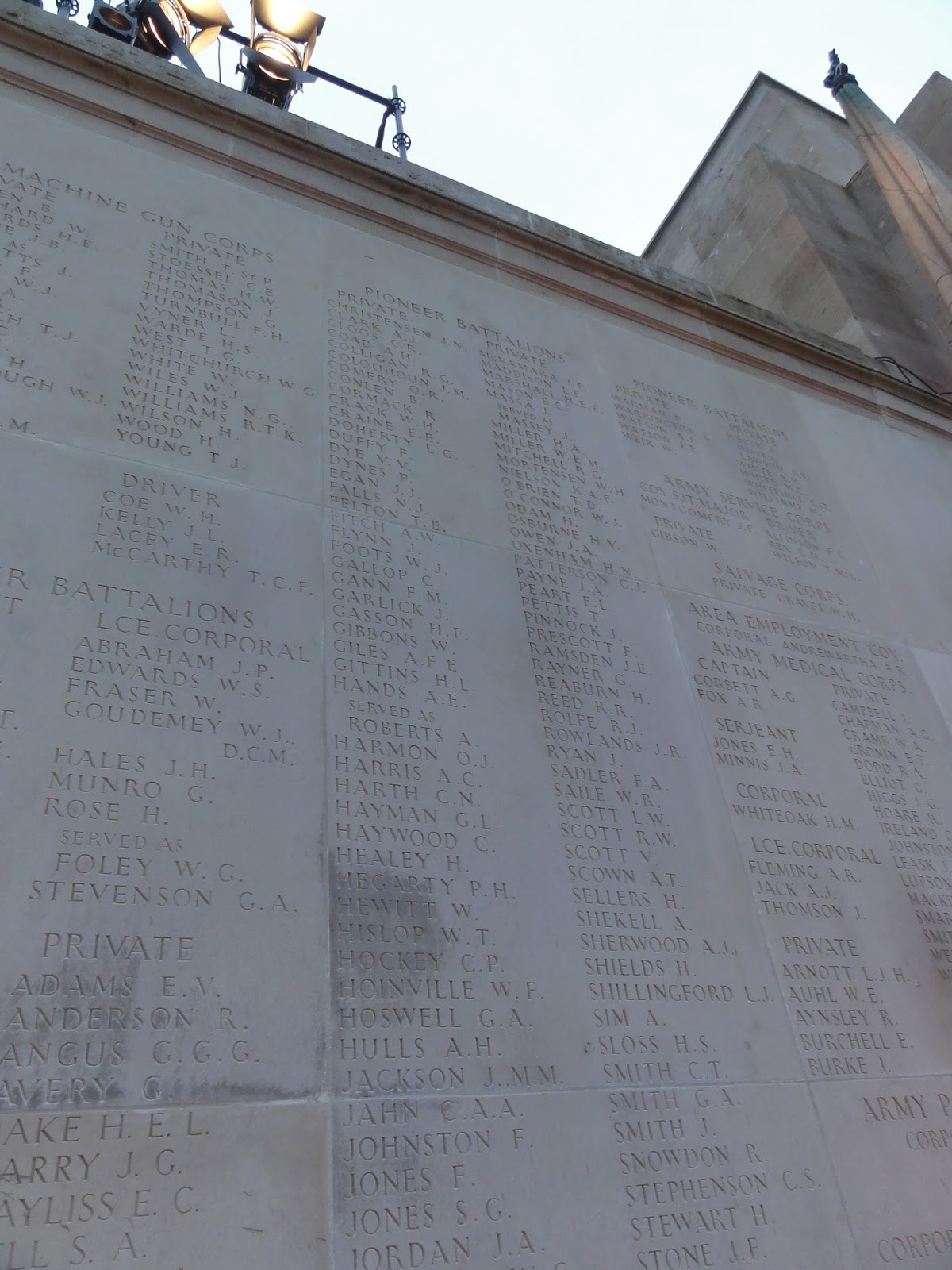
Most of us have ancestors and relations on the major memorials to the missing, like Villers-Bretonneux and the Menin Gate. Both are split by battalion, so it's crucial you have a record of this when you arrive. When it comes to the Menin Gate, the Commonwealth War Graves also provide a panel number to help you narrow down your search, but make sure you use the reference found on the PANEL LIST which is the second image provided rather than the Panel Reference or the Burial Register: all three will give you different numbers. You can place wired poppies alongside the names at these memorials, just like the Canberra AWM, but some at VB will be too high up, so you may need to place a memorial on a stick in the ground below instead.
An example of where to find the correct panel number
Villers-Bretonneux is more simple as the battalions are all Australian and listed in numerical order, starting with the infantry then the more specialised units such as the Pioneers.
I'd also recommend reading up on both war records and battalion histories to track where your ancestors fought. You want to pack light, so I recommend recording the information in a table you can print out or something similar.
2) Come prepared.
Before I left, I'd packed two things. One was an entire bag full of wired poppies for our group, the other was a zip-loc bag of sand from our local beach to sprinkle on the graves of the servicemen we would be visiting from our area. (Shhh - don't tell. While it's legal to bring sand into France, Australian law says you can't remove sand from a beach. Totally frigging hilarious when you consider the large amount which ends up in your towel, shoes, bathers and other places every time you visit, and no doubt just intended to stop those of us who live near one using it as a source for our kids' sand-pits etc.) However, when I got there I discovered lots of people had made up laminated cards with pictures and biographies of their relations, knitted poppies, clip-on koalas, football scarves and other tributes. I've read about people sprinkling graves with whiskey, beer, reading particular poems or stories at key sights and more. I wish I had done some of those things. Poppies were easy to buy locally, including wooden crosses which you can write messages on. I may be going again in 2017 and am already working on preparing cards for each of my relations as well as collecting suitable items to leave them.
Some of the Memorial Items at Hill 60 and the Adelaide Cemetery in Villers-Bretonneux
3) Make local networks.
Along the Western Front are many sellers of militaria, museums, visitor and tourist centres, all of whom offer a variety of services. You can collect maps and brochures which will greatly add to your understanding of your relatives' war service. You can buy items to help you remember their service. I personally chose to invest in vintage postcards of they type sent home by soldiers. Many of these have pictures of local areas, including showing the impact of the shelling. You can buy items from the infamous 'iron harvest' dug up by local farmers each year: shells, shot and 'trench art' from WW1, but I've been lead to believe virtually all of these will be confiscated by Australian customs so there isn't much point to purchasing any of it.
It's worth stopping to have a chat to anyone you can about what else they know and can share about the war. While at the Museum dedicated to the Battle of Passchendaele at Zonnebeke, I discovered that they were working on creating an archive of all soldiers listed on the Menin Gate. "Ah!" I thought. "I have a relative on the Menin Gate." On returning home I dutifully went to their archive centre's link to fill in the questionnaire about my 3x great-uncle's war service, sending in what I know about his life, family, enlistment and of course a picture, which will help them build up a more detailed and lasting record to commemorate those men who gave their lives in the defense of Passchendaele, Zonnebeke, Ypres/Ieper and surrounds. It turns out that while my 3x great uncle is officially 'missing', in that his body has never been recovered and formally interred in a war cemetery, his war record contains a map reference for his hasty burial during battle. British and allied war forces used a consistent mapping system, which you can see here. My ancestor is buried in a location on Map 28NE. The archive centre at Zonnebeke can help people in my situation by sending out a map indicating where the location is on a modern map so that next time I go, I'll be able to visit the exact spot my 3x great uncle fell. I think it's a safe bet I'll be the only member of my family ever to get do so, and I'm just delighted that I can represent my whole family in this way. The archive centre will take a few months to get onto the maps as they have quite a back-log, so leave yourself plenty of time before a visit to get it organised.
Maybe this is all you'll ever find, but maybe not: it's worth checking.
James Arthur Pearson White on the Menin Gate (L) and Charles Gallop on the Australian National Memorial at Villers-Bretonneux (R)
4) Just do it!
As the famous slogan goes... You'll never, ever know if you never, ever go. Or something like that. You can look at pictures and read all you like, but there's something about actually being in the locations of significance to your ancestors that makes you feel their story all around you. The Armchair Genealogist recently put together an excellent entry to help you organise your genealogical travel, and she's right. So get your Kindle stuffed full of appropriate reading for the long-haul flight*, start saving your pennies, get off your arse and plan that trip!
*I caught up on David Combe's newest, "The Three Rabbits Alibi". David takes stories discovered from some seriously top level Troving and then investigates them. Archives, Trove, colonial history and true crime in one delightful package.
The deal is that when nominated, one is to do the following:
Thank the person that nominated you and link back to that blog.
◾Share seven things about yourself – see below.
◾Nominate 15 bloggers you admire –or as many as you can think of!
◾Contact your bloggers to let them know you’ve tagged them for the One Lovely Blog Award
1. I swear even more in my internal monologue.
2. I am completely dependent on Pura Classic Mocha flavoured milk.
3. I watch less television than virtually every other person you know.
4. I have managed to reach middle age without ever leaving the country.
5. I've been doing serious family history research for more of my life than I haven't.
6. I really hope I started young enough to get it up to a standard and level of completion I'm happy with before I peg out, because I hate not seeing things through.
7. My idea of getting out for some exercise is going for a walk to visit relations at the cemetery.
15 bloggers:
She's been nominated previously, but I'm sure it's no shock one of my very favourite blogs is the completely awesome Clue Wagon: hitting the genealogy world with a much needed clue by four. I also enjoy hearing what Catie from Genealogically Speaking has to say. As a fellow Gen Xer (and person with few mutual relations), Alona from Lonetester always has something I find interesting and informative. Continuing on the age bracket theme, I highly recommend people go check out Carrie, DOM*, at Not Your Mother's Genealogy. Another must-see is Lynn's work on The Armchair Genealogist. They all rock! There's been a recent change of focus on the Rebel Hand blog to update those of us aiming to be 'shoestring genealogists' on bargain information sources. Of course I get all my genealogy tech tips from Thomas at Hack Genealogy and look to the good people from Geneartistry for ideas about how to incorporate more visual flair into presenting my research and displaying my heirlooms. It's been quiet on the blog front since Catherine passed away, but Saving Graves is still a must read for those with family buried in SA. Some related-to-but-not-actually-genealogy sites I follow include Victoriana Lady and The Thanatos Archive. Also along those lines I recommend Gerri Gray's Cemetery Photography. Just remember: the first rule of Cemetery Club is you don't talk about Cemetery Club. And, bending the rules because I can: the two people online whose every type written word I hang on are no doubt the good people behind literary analysis team Thug Notes and the recipe writing genii at Thug Kitchen. Love their work.
*Daughter of Myrt
Of course, being the foul-mouthed progeny of sailors you've come to know and... well, know, I'd much prefer to nominate people for the Totally Bitchin' Blog Award, or something like that. *Note to self: start Totally Bitchin' Blog Award when next have spare time*
I came across this while "Troving" the other day. It's nothing to do with my family, but it was quite interesting. I wonder what the author thinks this week's Lotto numbers are:
Aboriginal readers are warned that this blog post contains images of deceased persons.
I've really been enjoying the most recent season of Who Do You Think You Are? There's been an interesting selection of feature celebrities, and finally, at long last, there's been some content of direct relevance to my own research. The episode on Paul McDermott has been great for clarifying which SA McDermotts are from which branch. As is typical with Irish families, they all have the same names, so that's been incredibly helpful despite the lack of Irish content (I'd always hoped Paul would be selected, although didn't think it would ever happen, and I'd be able to get help with the Irish brick-wall! Sadly beyond mentioning where the family are from they didn't go there at all.)
You can see why I never expected this to happen. Who picks this guy to be the subject of a TV show aimed at baby boomers?
The episode it turned out was the most interesting was one I didn't expect: the episode featuring Adam Goodes. It's made me ponder a number of issues about my family's role in our nation's history. I've alluded before to one of my Dirty Rotten Scoundrels, Thomas Skermer. Thomas was at one stage a Trooper who was employed to "quell disturbances with the blacks" in the state's mid-north. However, it's not the only time a family member had recorded* interactions with the First Australians.
In 1896, my 3x great aunt Euphemia Dorey married William Finlayson in the Bible Christian Manse at Kadina. The couple spent the early years of their marriage at Point Pearce Mission Station, where William worked as the Chaplain. Located on Narungga land, the Mission Station had become a place where Aboriginals from different People throughout central SA were herded together and put in an environment designed to strip them of their language, heritage, culture, and assimilate them into the European community. There were positives and negatives to William's involvement. He was a deeply religious man, and I've no doubt was motivated by good intentions. However, he was part of a paternalistic system which we know had devastating long-term effects on the Aboriginal people.
These two pictures were shown during the program, and I'd love to know more about them. The white girl on the right bears a distinct resemblance to another picture I have of a niece of Euphemia's.
In 1906 William made an abrupt career change. One of the areas of my research is focusing on trying to discover what motivated this. He became a wheat buyer for Wells & Co., working with his brother-in-law Walter. Based on the Yorke Peninsula, his work took him on regular trips across to the Eyre Peninsula. It was there that he died in 1910 and he is buried in the Cowell Cemetery. The cause of death was alcohol poisoning, and it was reported at the inquest that he was alcoholic, something which poses further questions. Was this the cause of a dismissal as chaplain, was it a response to losing his job, or something else? Euphemia was left to look after her seven children, aged between 14 and 1. Unusually, not only was Euphemia able to provide for the family, the children were quite well educated. Douglas became a Pharmacist for example, as was Clem, and Robina became a teacher.
Report of William's Death in The Register, focusing on his very recent work history
In 1929 the youngest daughter, Mary, married Martin Chemnitz Kriewaldt, a lawyer who had been educated in the US and in Adelaide. His father was a Lutheran minister, a man who had an interest in Aboriginal missions which may have lead to the two meeting. The couple lived in the leafy eastern suburbs, and frequently appeared in the society pages. Their lifestyles couldn't have been further apart from that of the Wanganeens, Sansburies, O'Loughlins and other families among whom Mary was born. However, this didn't bring them lasting happiness. Their marriage ended in 1947, and Kriewaldt moved to the Northern Territory. "Big Feller Judge" is described as having unusually enlightened perspectives on Aboriginal issues in records of his career such as that at the University of Queensland, and is regarded as having set a new benchmark for fairness in legal decisions affecting Aboriginal people at the time. Despite this he ended up becoming most remembered for being the judge who sentenced Albert Namatjira. Records suggest this case devastated Kriewaldt, and he died shortly afterwards, as did Namatjira (whose artwork had always adorned Kriewaldt's office). Kriewaldt was also a supporter of assimilation policies.
Mary and her daughter Rosemary in the newspaper in 1939
The story of this part of my family is extremely sad. While Thomas Skermer may have participated in literal genocide, this branch of my family were engaged in cultural genocide. They were people who wanted good outcomes, and I think it would have broken their hearts if they had realised the terrible consequences of the systems in which they participated, outcomes so clearly illustrated in the story about Adam Goodes and his family.
Nearly two years ago, while on holiday on the Yorke Peninsula, I thought that I should travel to Point Pearce and take a good look at some of the consequences of actions carried out not only by European settlers and the systems we introduced as a whole, but by my family quite directly. This is what I saw:
The Chapel
One of the Original Buildings
Point Pearce is not a pleasant place to be. There are bars over all the windows. There is nothing growing, and a lot of evidence of vandalism. Aside from the school, which is beautifully maintained but set behind 7 foot fences, most of the buildings are quite spartan. There are no shops or offices providing employment or quality of life. I spoke to one of the residents, who said that it can be truly terrifying at night. My children and I watched children play in facilities I'd associate more with a developing country than a Yorke Peninsula coastal town, and my heart ached for them.
The Park
Although they never, ever intended this, the current situation in Point Pearce is the outcome of those policies of protectionism and assimilation pursued by members of my family. Their actions disconnected Aboriginal people from their lands and culture, leading to loss of identity and inner-brokeness which are still making their presence very much felt in Point Pearce in 2014. I am certain my family were good people. I'm certain they did what they did because they wanted the best. However, we know that's not the effect it had, and for that, I am sure they would want to apologise.
In his Refern Speech, Paul Keating very famously said that "the starting point might be to recognise that the problem starts with us non-Aboriginal Australians. It begins, I think, with the act of recognition. Recognition that it was we who did the dispossessing. We took the traditional lands and smashed the traditional way of life. We brought the disasters. The alcohol. We committed the murders. We took the children from their mothers. We practised discrimination and exclusion. It was our ignorance and our prejudice. And our failure to imagine these things being done to us. With some noble exceptions, we failed to make the most basic human response and enter into their hearts and minds. We failed to ask – how would I feel if this were done to me? As a consequence, we failed to see that what we were doing degraded all of us." When I hear that speech, I know that 'we' refers not just to a culture of which I am a part, but of my very own family, and I am sorry for the actions of both.
I think those of us in the genealogy community could be perceived as focusing on only one side of the pioneering stories, celebrating their triumphs and being responsible for perpetuating an image of the 'good old days' which white-washes over Aboriginal experience of these events. However, I don't think it needs to be that way. Just as researchers have made huge progress in how they report illegitimacy, criminality, homosexuality or other formerly taboo topics in their family histories, I think we can make progress here too. In fact, I think we have a number of interests in common with Aboriginal people. We have a shared belief in the importance of connecting to heritage and culture. We know the impact this connection has on our sense of identity and community. When we travel through the city or country we connect the landscape in which we find ourselves with the stories of our ancestors, and we're most likely to be leading the charge to preserve graves, buildings and features which we see as integral to our history. I think it's fair to suggest we are well placed to have better than average insight into the importance of Aboriginal connections to the land, the Dreaming stories and sacred sites. Keating described the test of how seriously we believed in a fair go for everyone as a test of 'self-knowledge' and 'how well we know the land, how we know our history'. Surely there's nobody better equipped to pass that test than us genealogists. * I say recorded, because as a person who has SA pioneers in my ancestry. I'm guessing at least some would have taken an active role in Frontier Wars.
I've had a bit of a hiatus lately dealing with some living relative issues (What? We have to pay attention to them before they are dead now?) In the meantime, here's a Friday funny. Although it's not Friday.
My great-great Uncle Hubert Clive McPherson was a born in Walkerville in 1886. In 1912, he married Rachel Jane Hunt in St. John's Church in Glebe, NSW.
Nothing eventful so far... right?
When he enlisted for the war in 1915 he gave his wife's details (New Farm, Brisbane), however, his own residential address was that of his parents in Adelaide and he set up his pay allotment as going to his mother. Seems a little rocky to me. Hubert returned from the war with a hearing impairment from the mortar bombs but otherwise OK. Hubert and Rachel were still referred to as married in 1927 (The Advertiser) but were most definitely separated at the time of a dispute over his pay in 1933 during which time Rachel was back in Sydney.
In 1938 Bert took a young woman named Maude Howsen with him to Rabaul, PNG. He worked for the Australian Government in the Lands Department, and Maude worked as a dressmaker. The couple were there as the Japanese were sweeping their way to Port Moresby, and they were evacuated from PNG. Maude was evacuated on the MV Neptuna in Dec 1941, arriving in Townsville on Boxing Day. Hubert travelled shortly after aboard the MV Malaita, arriving in Cairns on 18 Feb 1942. Two weeks later, Bert's wife Rachel died of breast cancer at the Home of Peace in Marrickville. She was only 55.
Maude and Bert lived separately for a short time, Bert establishing a home in Bowen Terrace, New Farm, Brisbane, only a few streets from Rachel's war-time residence.
The home Maude and Bert lived in, New Farm
Maude joined him, and they later moved to Bundaberg. Hubert died there in 1962, and Maude 10 years later. For some reason Hubert was cremated in Brisbane, but Maude is buried in Bundaberg. Hubert's death certificate says they married in 1942, the year of Rachel's death, but I can't find any record of a marriage between the two. The couple never had any children.
The family legends about Maude were very unhelpful. My grandmother told me her she was a Vaudeville dancer, for example, which she wasn't. It's obvious the McPhersons didn't approve of Bert's domestic situation.
So, the big mystery was, who was Maude Howsen? She had just appeared on the boat to Rabaul. Where had she come from? Maude Howsen or informants indicated she was born in 1888 in Kiama (Cemetery Index, Bundaberg) to Peter Howsen and Fanny Chester, and it was searching for that, and Ancestry's terrific matching capabilities, which lead me to the family of Elizabeth Maude Ettingshausen, of Kiama, and Maude's ancestry was discovered. It also helped me fill in a little of her life before Bert. The Sydney Morning Herald and electoral rolls indicate that between 1923 and 1933 Maude was a music teacher. She lived in Bankstown, then Victoria Road in Punchbowl. No doubt he met her in Sydney, just as he had his first wife. I've recently been in touch with members of the Ettingshausen family, and look forward to finding out more about Maude.
Hubert and an unknown woman, possibly Maude
Thanks to the good folks at Gasworks Hotel for spotting the error in the first line!