Showing posts with label WW1. Show all posts

Sunday, 11 June 2017

Why is it always you, Jimmy?

So, recently I've been lucky enough to go to France and Belgium again for work. (The struggle is real, people. The struggle is real.) This time I was in charge of putting together the itinerary, and while I was the soul of restraint and did NOT stuff it full of things about my family, I did squeeze one significant one in. We visited the Passchendaele Archives/Musee de Passchendaele in Zonnebeke, which in itself is a great experience which I recommend to you. From there, we set off on foot to our next destination, Tyne Cot Cemetery, which has always been visited on our trip but usually by bus. The walk to Tyne Cot is not as pretty as many which surround the museum, but it's highly significant: the walkway used to be the railway line along which troops marched to notable skirmishes such as the Battle of Broodseinde. I know from his war record that James Arthur Pearson White spent the last day of his life marching along that exact path: the noise, the smells, the devastated landscape, the fear...

Sign at the start of the walkway to Tyne Cot

Along the walkway are plenty of remnants from the war, although there are also fields being ploughed, birds singing and other pilgrims walking back in the other direction. It's hard to imagine what it must have been like 99.5 years ago when Jim took this same route to his final resting place.

Some of the remnants of war alongside the path

As I have previously mentioned, the archivist had supplied me with a modern map showing the field (and it is literally a field) in which Jim was killed by a shell, either while nursing a wound or just suddenly. I don't know that I'll ever have the opportunity to visit that field again, but for ten minutes on a sunny but chilly afternoon in April, a descendant of Ben and Lydia White was able to stand at the spot in which their son lost his life, on behalf of all those who remembered and loved Our Jim but lived out their lives a world away in Australia.

The field in which James Arthur Pearson White was killed outright by a German shell

While Jim's remains have never been identified, it's very likely that after the war they were discovered and removed to the Tyne Cot cemetery, the Commonwealth War Cemetery in the world. However, with so many graves the experience is quite different to visiting one individual soldier from the family. This makes my second Tyne Cot visit, and I feel far more as though I have had the chance to pay my respects to Jim in the field than in the Cemetery where he probably lies, unknown but not unloved.

Tyne Cot Cemetery

Of course the day concluded with a visit to the Menin Gate Memorial to the Missing and attendance at the Last Post Ceremony, and on this occasion someone was flying in a hot air balloon, high above the arch where we stood paying our respects to Jim and to all of those men missing in Flanders Fields.

Fly free, Jim xxx

For Lydia. For Ben. For Florence. For Elsie. For Diana. For all of us.

Lest we forget.

Saturday, 6 June 2015

Not all those who Wander are Lost

As those of you who've read previous entries will know, this year was when I was travelling to Paris and to the Western Front. It was a work trip, so couldn't be focused around my genealogy interests, but there were always going to be several opportunities along the way. It really didn't disappoint.

I don't know that I will ever be able to do justice to the amazing experience which I had, tracing the footsteps of the many members of my family who made that same journey 100 years ago. I stood on battlefields where cousins bled and died, a long way from home. I sat overlooking the infamous Sausage Valley in Pozieres which I know cost at least one of my ancestors his sanity. I walked down streets great-uncles were paraded on as prisoners of war, I saw plaques commemorating sons whose mothers were never given the opportunity to leave flowers... all among pristine and picturesque scenery, where 100 years ago there was just mud and ruin. There really are no words, and I'm not really going to blog a report of the trip because I can't even begin to explain those experiences and how grateful I am to have had them. Paris was beautiful of course, but it's the Western Front that will stay with me for years to come.

What I am going to blog about is some tips which may be of benefit to any readers contemplating such a trip in future, so that you can make the most of your visit.

1) Do your homework.

If you're going to the Western Front, it's time to get your maps out! There are 100s of cemeteries dotted across the Western Front, and while many are well sign-posted, not all of them are. I highly recommend arriving not just with cemetery maps but also maps for where to locate each of the cemeteries you are after. I'd also suggest mapping your suggested route so that you can work out which are are passing and in what order. Those of us who have grown up on stories about the compact nature of the Front Lines tend to think this will all be much closer together than it really is. The Commonwealth War Graves Commission provides maps and directions as part of the search results for the servicemen at http://www.cwgc.org/

You need:
  • Overall map of your route
  • Directions to the cemeteries
  • Maps of the cemeteries themselves

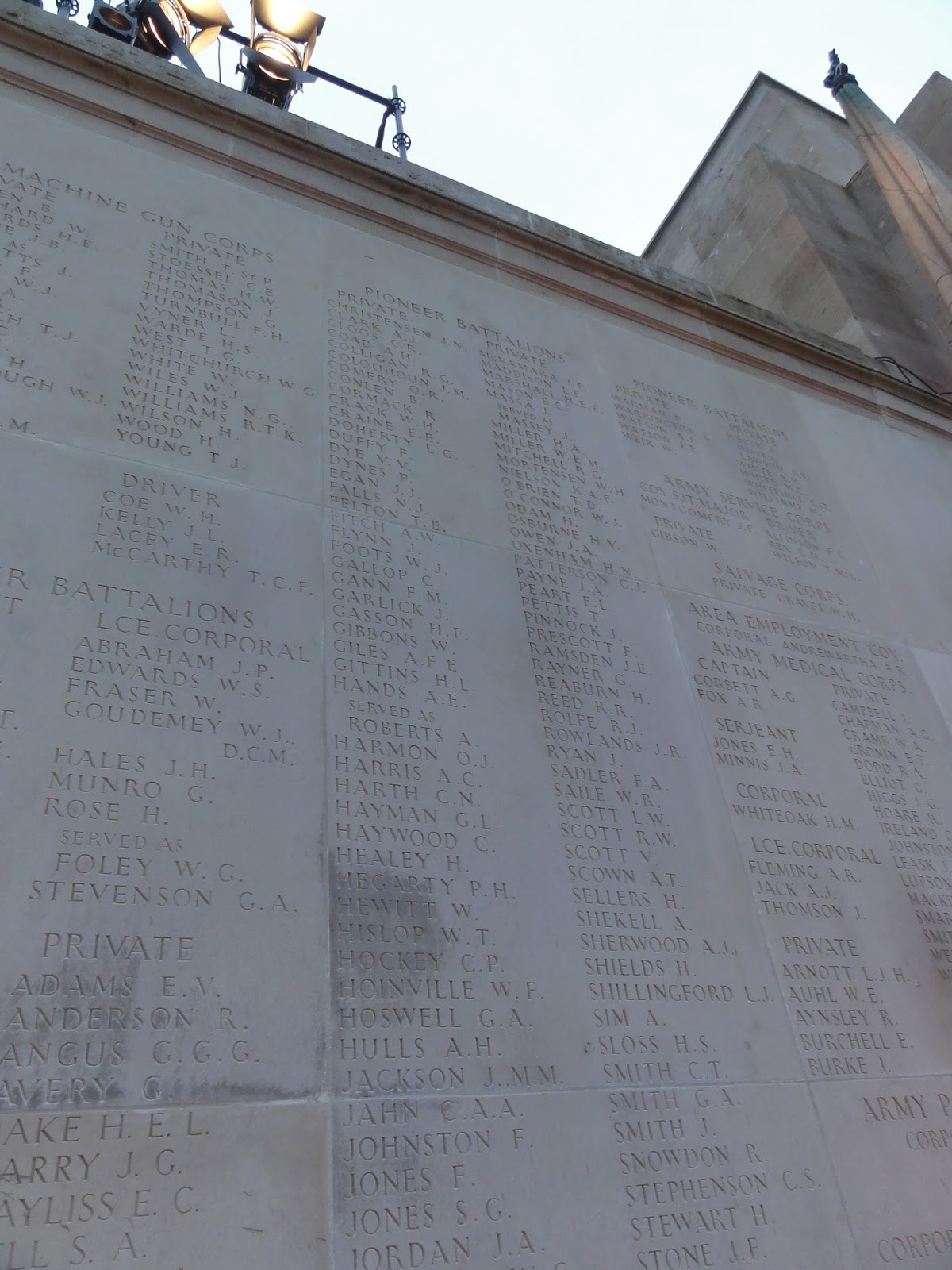
Most of us have ancestors and relations on the major memorials to the missing, like Villers-Bretonneux and the Menin Gate. Both are split by battalion, so it's crucial you have a record of this when you arrive. When it comes to the Menin Gate, the Commonwealth War Graves also provide a panel number to help you narrow down your search, but make sure you use the reference found on the PANEL LIST which is the second image provided rather than the Panel Reference or the Burial Register: all three will give you different numbers. You can place wired poppies alongside the names at these memorials, just like the Canberra AWM, but some at VB will be too high up, so you may need to place a memorial on a stick in the ground below instead.

An example of where to find the correct panel number

Villers-Bretonneux is more simple as the battalions are all Australian and listed in numerical order, starting with the infantry then the more specialised units such as the Pioneers.

I'd also recommend reading up on both war records and battalion histories to track where your ancestors fought. You want to pack light, so I recommend recording the information in a table you can print out or something similar.

2) Come prepared.

Before I left, I'd packed two things. One was an entire bag full of wired poppies for our group, the other was a zip-loc bag of sand from our local beach to sprinkle on the graves of the servicemen we would be visiting from our area. (Shhh - don't tell. While it's legal to bring sand into France, Australian law says you can't remove sand from a beach. Totally frigging hilarious when you consider the large amount which ends up in your towel, shoes, bathers and other places every time you visit, and no doubt just intended to stop those of us who live near one using it as a source for our kids' sand-pits etc.) However, when I got there I discovered lots of people had made up laminated cards with pictures and biographies of their relations, knitted poppies, clip-on koalas, football scarves and other tributes. I've read about people sprinkling graves with whiskey, beer, reading particular poems or stories at key sights and more. I wish I had done some of those things. Poppies were easy to buy locally, including wooden crosses which you can write messages on. I may be going again in 2017 and am already working on preparing cards for each of my relations as well as collecting suitable items to leave them.

 
Some of the Memorial Items at Hill 60 and the Adelaide Cemetery in Villers-Bretonneux

3) Make local networks.

Along the Western Front are many sellers of militaria, museums, visitor and tourist centres, all of whom offer a variety of services. You can collect maps and brochures which will greatly add to your understanding of your relatives' war service. You can buy items to help you remember their service. I personally chose to invest in vintage postcards of they type sent home by soldiers. Many of these have pictures of local areas, including showing the impact of the shelling. You can buy items from the infamous 'iron harvest' dug up by local farmers each year: shells, shot and 'trench art' from WW1, but I've been lead to believe virtually all of these will be confiscated by Australian customs so there isn't much point to purchasing any of it. 

It's worth stopping to have a chat to anyone you can about what else they know and can share about the war. While at the Museum dedicated to the Battle of Passchendaele at Zonnebeke, I discovered that they were working on creating an archive of all soldiers listed on the Menin Gate. "Ah!" I thought. "I have a relative on the Menin Gate." On returning home I dutifully went to their archive centre's link to fill in the questionnaire about my 3x great-uncle's war service, sending in what I know about his life, family, enlistment and of course a picture, which will help them build up a more detailed and lasting record to commemorate those men who gave their lives in the defense of Passchendaele, Zonnebeke, Ypres/Ieper and surrounds. It turns out that while my 3x great uncle is officially 'missing', in that his body has never been recovered and formally interred in a war cemetery, his war record contains a map reference for his hasty burial during battle. British and allied war forces used a consistent mapping system, which you can see here. My ancestor is buried in a location on Map 28NE. The archive centre at Zonnebeke can help people in my situation by sending out a map indicating where the location is on a modern map so that next time I go, I'll be able to visit the exact spot my 3x great uncle fell. I think it's a safe bet I'll be the only member of my family ever to get do so, and I'm just delighted that I can represent my whole family in this way. The archive centre will take a few months to get onto the maps as they have quite a back-log, so leave yourself plenty of time before a visit to get it organised.

Maybe this is all you'll ever find, but maybe not: it's worth checking.
James Arthur Pearson White on the Menin Gate (L) and Charles Gallop on the Australian National Memorial at Villers-Bretonneux (R)


4) Just do it!

As the famous slogan goes... You'll never, ever know if you never, ever go. Or something like that. You can look at pictures and read all you like, but there's something about actually being in the locations of significance to your ancestors that makes you feel their story all around you. The Armchair Genealogist recently put together an excellent entry to help you organise your genealogical travel, and she's right. So get your Kindle stuffed full of appropriate reading for the long-haul flight*, start saving your pennies, get off your arse and plan that trip!

*I caught up on David Combe's newest, "The Three Rabbits Alibi". David takes stories discovered from some seriously top level Troving and then investigates them. Archives, Trove, colonial history and true crime in one delightful package.

Monday, 10 March 2014

Enlisted on the Other Front

So, sensational news during the week. Yours truly is being sent by work to the French battlefields for the Villers-Bretonneux dawn service, ANZAC Day '15. Naturally this is terribly exciting for all sorts of reasons, but part of the excitement is definitely because of the genealogy potential. Before I go I will be checking the locations of service for all my relatives who served in WW1, especially those who never returned.

It will be almost 100 years since, in September 1915, my great-grandfather Francis enlisted for the war. He left his wife, toddler and four month old baby and travelled to France, no doubt spending time in Paris as I will, before heading to the Front where he was a Driver in the Field Artillery. Francis was shot in the jaw in August 1917. It was a near thing for him, but Francis and his brothers (all three of whom served) were lucky: they all came home at the war's conclusion. His son would not be so lucky when the next war rolled around.

Like most, I have my share of family World War 1 stories that didn't end very well at all, like William Matthew Colbert who entered the war underage using an assumed name, confessing on his death bed to his real details so his mother would be told what had happened. He was 17. However, the person I'm going to write about today had quite a different situation:

In 1915, Victorian Blacksmith James Arthur Pearson White enlisted to serve in the Australian Imperial Force. The Darby book tells us that Jim enlisted in the 27th Battalian of the AIF. He was been sent home to recuperate from a knee injury, but he re-embarked and joined the 43rd Battalian. He was killed only eleven days after arriving back at the front, on 10 Oct 1917. Family legend has it that Walter (Jim's brother who was also at the Front)  had spoken to Jim late in 1917 and they had arranged to meet the day he was killed. It also says he married while away and that his wife and daughter came out to Australia after the war.

James Arthur Pearson White, from The Darby Book

Most of you will have realised I'm not one to take things at face value, so of course I revisited everything to see what I could find out about James myself.  In his war record, there is a conflict alluded to between my great-great-grandmother, Lydia White nee Pearson, and James' English wife, Elsie, over whether Lydia or Elsie's daughter Diana (also referred to as Dinnia) were entitled to James' war medals etc. There is a date of marriage given (Registrar's Office, Cardiff Street Oxford, on 12 May 1917), and an address for Diana, 5 Bath Place, Holywell, which is turns out is a tiny lane off a road which passes through Oxford University, now the site of a hotel.


Bath Place off Holywell Street, Oxford

After extensive digging, I have been unable to locate any marriage between the two. Elsewhere in Jim's war record Elsie is referred to as his "unmarried wife", so I have formed the view they were never actually legally married but only said they were to meet some army administrative requirement. I did, however, find an Elsie at 5 Bath Place, Holywell, in the 1911 census: Elsie Walklett, daughter of John and Mary. While there are two other Elsie Walkletts who married in the 1920s, the only marriage I could find in Oxford, or during WW1, for an Elsie Walklett was to Albert E Drewett in 1915. I also found a birth entry for Diana Drewett in Oxford in the first quarter 1917. Naturally the correlation of names meant that I wanted to find out more about the Drewetts to see if there was a connection. 

The BBC's Remembrance Page says that Albert E Drewett enlisted in the 1/4 Bn, Oxfordshire and Buckinghamshire Light Infantry, previously residing in Oxford, Oxfordshire. The author of this post also wrote on Genforum that Albert married Elsie Walklett. He died on active service on 21 May 1917 and was laid to rest at Hermes British Cemetery in Pas de Calais. He was 24. 
The entry is from a niece of Elsie's. I suspect were we to compare notes, we would find that Elsie and Albert married when she was expecting Ivy, her first child. Albert then enlisted, and Elsie met a young Australian soldier who became her lover. When she fell pregnant, she and the soldier deemed it expedient to claim they had married.

The whole story is tragic. Jim's mother (my 2x great grandmother) had separated from her husband and was reliant on her sons for income. In addition to her grief, his death had serious financial implications for her. She was very shocked about his relationship and the probability he had fathered a child. Meanwhile, Elsie suffered the loss of her husband and her lover, and was left to raise a baby and toddler alone. The daughters were left without their father, and who knows what the Drewetts thought about the whole situation!

Letter from Elsie Walklett to the Red Cross

I have not been able to discover exactly what happened to Elsie and Diana after the war. There is a Diana Drewett who married a Mr. Nutt in the 30s in Oxford, who may be our Diana, but with three different surnames and two different countries to look in it has proved quite difficult. I wonder what Elsie and Diana's relations know about Diana's paternity, given the documents relating to it are probably only in Australian records which they may never have thought to look at (and why would you?)

Most blog entries about War service very rightly focus on the lives and deaths of those men who enlisted for active duty, but whenever I become aware of a story like this I am reminded of the truth of Milton's words, that truly "They also serve who only stand and wait".

Timeline of Events:
Jan 1915 Albert and Elsie marry
Jun 1915 (quarter) Their daughter Ivy is born
August 1915 Jim enlists for the war
Mar 1916 Jim is in France
Mar 1916 Jim injures his knee, three days after arriving at the Front
May 1916 He is sent to the UK to recuperate
Diana is conceived
Jun 1916 Jim is sent back to Australia for three months
Jan – Mar 1917 Diana is born
Feb 1917 Jim arrives back in the UK
May 1917 Jim allegedly marries Elsie
Albert dies
Sep 1917 Jim is sent back to France
Oct 1917 Jim is killed, only a couple of weeks after arriving back at the Front