Showing posts with label Ethical Dilemmas. Show all posts

Friday, 20 September 2013

Ethical Dilemmas #2 - Geneabloggers Open Thread Thursday

It's been very busy lately, so I'm going to be using my genealogy time to utilise my new spiffy Findmypast subscription rather than blogging this weekend - I need to relax! However, I had to chip in on the Geneabloggers Open Thread Thursday topic for the week: Ethical Dilemmas. I'm not going to blog about specific ethical dilemmas, as that's something I do regularly in  my blog (eg Mervyn Dawson, THAT family heirloom etc.) However, I'm going to list my key considerations when it comes to disclosing information.

1. I firstly always consider those who are living. If it's going to be deeply distressing or humiliating for a living relative, negative about them or adversely affect them, then there's no question I'd keep it on the down-low.

2. I also consider whether social attitudes have changed on the issue at hand. For example, illegitimacy has no social stigma now, so it doesn't trouble me to find out about that or share it. Nobody who hears it is going to think any the worse of my ancestor/relative now. In fact, often it's quite the opposite: people have more admiration for them for having faced adversity, or they enjoy having a connection to a good scandal or a total scoundrel.

3. If I think it will be a bit upsetting to someone, I may still share if I think there's a greater interest or another angle on things. For example, there are some cousins who might find the lack of genuine Scottish DNA on the part of Samuel McPherson a cause for concern. However, I maintain ongoing interest in all things Scottish is perfectly appropriate to those descended from someone raised by a Scotsman. It was part of how Samuel was brought up and what he was taught. The fact his actual genes came from elsewhere doesn't alter or lessen the impact that has had on our family and their identity. We know he saw John McPherson as his father. Not only that, I think the story of his true biological heritage brings another degree of richness to our family, and has always been part of our family story too (you can't turf his 'real' dad without turfing his 'real' grandma, who it turned out was also part of the heritage we'd been handed on.)

Apart from that, I've got to say I'm from the Publish and be damned club. Nobody wants to read a genealogy which makes the entire family sound like a bunch of sanctimonious fuckers. In addition, I'm not a big fan of cherry-picking in any form of life: you deal with the facts as they are and in their entirety. Then of course there's the fact that I'm generally lacking in gentle/subtle approaches or the ability to give a shit what anyone else thinks: those who know me personally know that for me, every day is Tell It Like It Is Tuesday! (I am, conversely, very hard to offend or upset.)

In answer to the title question, is there a 'right' to do genealogy? I say 'damn straight'!

And just to further get into the Tell It Like It Is Tuesday spirit...
 
As a totally off-topic addition, today I received a rather exhilarating geneaboost. I have many of my media files on Ancestry, including the marriage certificate of my semi-brick wall great-grandfather, Patrick McDermott, for whom I have never located a living relative aside from my immediate family. Consequently I went temporarily insane with excitement today to discover the following comment added to the file, which has been there unremarked upon for three and a half years: "Found this Certificate of Marriage in with family documents."
 
Can it be? Has someone found a copy of this certificate in a box they are clearing out, and checked on Ancestry to see what they can find out about the people it belonged to? Could this person turn out to be related to Patrick's brother who was alleged to have moved to Australia? Could his/her ancestors have known my ancestors? Will I find out more about Patrick? I shelled out $10 for a pay-per-record Ancestry subscription* just so I could message the comment's author, so I hope I hear back SOON!
 
*I have previously had a World Heritage subscription, but have rather exhausted the current records so decided to switch to Findmypast for the financial year and check out their stuff instead.

Saturday, 20 July 2013

Ethical Dilemmas #1

There's no doubt it's tricky at times being into genealogy. There's the ethics of using other people's information (yes, we all know you shouldn't just copy stuff without appropriate attribution, except for YOU Gen Y and whoever those weirdos are from other age groups who think it's ok to use other people's stuff without so much as a 'sourced from cousin Fred' or, even worse, pass it off as their own), there's the ethics of whether or not to share particular discoveries (something I'll be revisiting in a later blog), the ethics of handling living people's information etc. etc. The list goes on!
 
Recently, I've discovered a whole new ethical issue which I haven't really seen people write about: handling heirlooms. Like most genealogists, I've become a person who people give stuff to, because it's old, because they don't want it but are pretty sure it shouldn't just be thrown out, because they think I'll look after it. I currently have a half a cupboard full of miscellaneous family treasures from my family and my husband's family. This has raised a couple of issues:
 
1) Who actually should have the item in the first place?
 
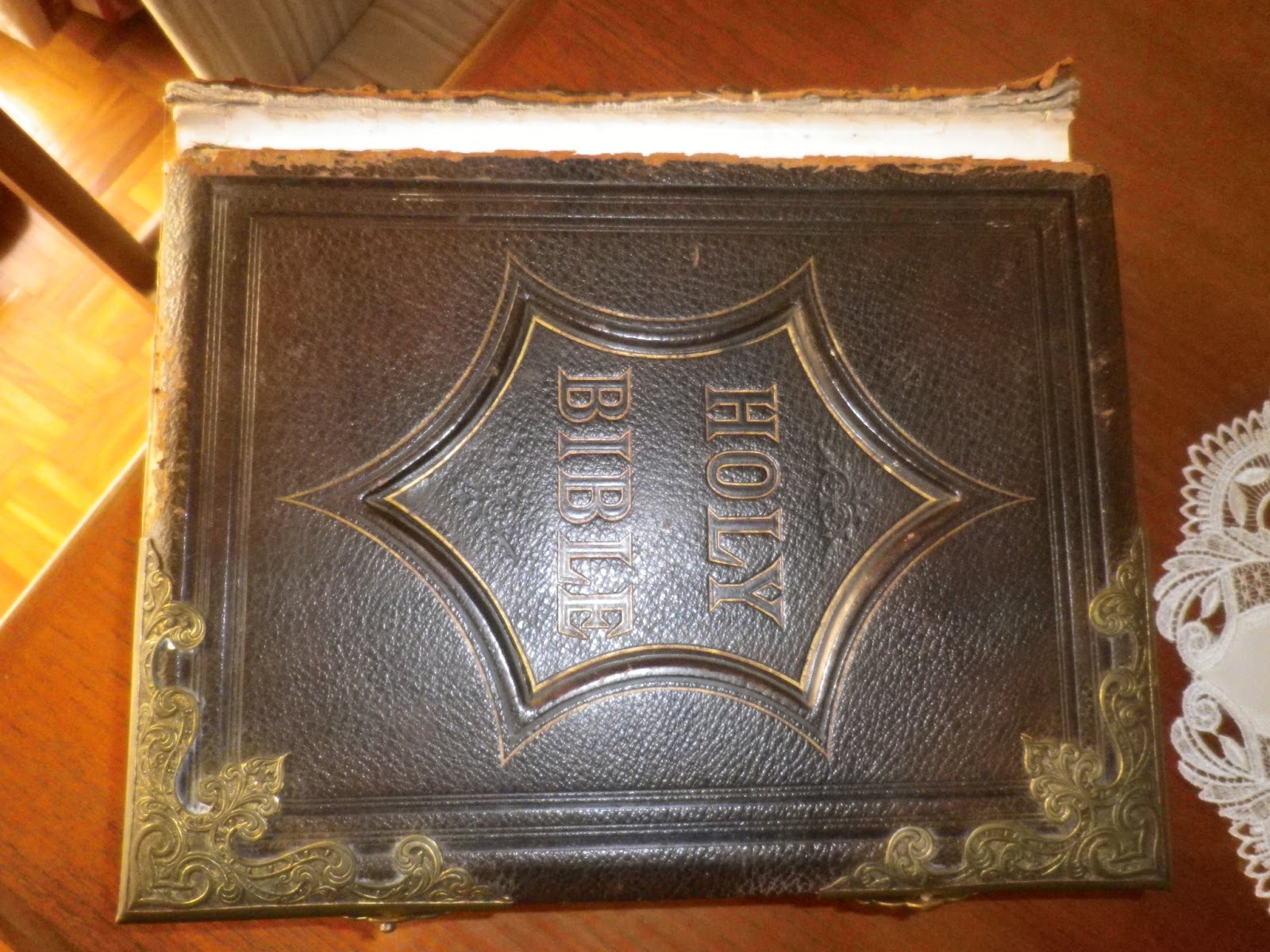
I've previously mentioned the case of the Family Bible in my blog, because of its significance to my own personal genealogical journey. It was given to my great-grandparents, William Evans and Florence Gough for their wedding in 1888. Since then it has belonged to my great-aunt Mabel, my grandmother Gwen, my mum, and now me. Mabel was the oldest in the family, but she used to let her kids play with it (hence its broken spine and loose pages). Apart from us all being female there is no 'pattern' to who has received it since. My grandmother decided to get it from Mabel for my mum, and mum decided I should have it as she knows how much it means to me and felt it would be most valued in my home. However, I have numerous cousins who have just as much 'right' to it as I do.
 
 
And they can prise it from my cold, dead hands, 'cause I am not parting with this baby!
 
As a subset of that, when two people have equal 'right', who decides what should happen and how? My great-grandfather had medals from WW1. Grandma thought she had them and had given them to my father, but mum swears black and blue that never happened. Anyhoo, another relative has been looking for them. I made the point that perhaps one of Grandma's sister's children has them. Well, said relative launched into a rant about how, if that has happened, we should just demand them back. Um... why? What makes them more 'ours' than 'theirs'? I'd love to find out if they do have the medals for general interest, and so I can get a photo of them, but if they have the medals I don't see there is a damn thing we can (or ought) do about it claiming them.
 
This is all well and good, but what do you then do with the item when you have received it and feel someone else has more right to it than you do? We have in our house a trophy a certain family member received for his involvement in a particular sporting endeavour. Hubby has a cousin who is also heavily involved in that particular sport, even carrying out the same role in the team. Hubby has strongly resisted any suggestions that the item should be handed over to his cousin. Decisions, decisions!
 
2) When you own the item, what criteria do you use to work out who to pass it on to next?
 
In our family we are lucky to have two sets of war medals. One belonged to my husband's grandfather, Mervyn Sykes. He served in WW2. They are beaten up looking as Merv was very into the RSL so routinely had them out for occasions. He was also a total pisshead so he was none too careful on said occasions. Hubby always said they were to go to our son 'because he was a boy'. Not because he was the eldest, not because he was interested (he's only 4!) but because he's a boy. Setting aside my feminist inclination to scream "Dude! What the actual even?", it is on reflection the way hubby received them. His father got them because he was the boy in a family full of girls. At least, as Francis Fulford identified when discussing primogeniture in The F***ing Fulfords, it's consistent. And thankfully we have two sets of medals, because we also have two boys, as much as I'd have loved to watch hubby's head implode trying to work out which should get the one set.
 
 
Medals awarded to Ron McPherson in WW2 - in pristine condition, because he never came home from El Alamein.
 
I haven't made up my mind yet about how I'll pass on the items I have. Thankfully being a (relatively) youthful type, it's not something I am statistically likely to consider for a bit just yet. I think I'll wait and see whether the kids are interested, their partners are interested, their kids are interested, what the nieces would value, other cousins etc. Mainly I'll be looking to pass them on to the people I think will treasure them the most and ensure they are shared and passed on, regardless of their degree or type of relationship.
 
3) In what ways do you share the item with others?
 
I personally photograph each and every one of the items which come into my possession and make those pictures available to anyone who asks. I show them to family members who visit, and if anyone ever needed to borrow one for a particular purpose then I'm sure we'd be able to work something out. I have a cousin who loaned me a prayer book for my wedding which my great-great grandparents had bought for her grandmother and which every bride in her branch has carried on their wedding day (which she's never asked for since, so I'm not sure if she intends to keep it or whether I'm supposed to keep it until the next family wedding! Eeep!) However, I do have one cousin who won't even send a photo of some items she's got, and another person I visit won't ever get anything out to let me photograph it. Weird...
 
Of course then there's the whole dilemma of what one ought to do if there was a divorce in the family, what you should do if you find a prized possession that doesn't belong to your family (we all know you use resources like Rootsweb mailing lists to track a rightful owner if you can, right?) and who knows what other scenarios.
 
At least we can all agree on one thing!